
 The grammatical gender is a hard bone to chew for English speakers, for two main reasons. First, because we don’t have it in English, and second, because there is no logic to decide if a word is feminine or masculine. Actually, if you compare, for example, Spanish, English and German, you find this:
English: the table (no grammatical gender)
Spanish: la mesa (feminine)
German: der Tisch (masculine)
Although it is not a problem to assign feminine and masculine gender to animals or people, because we connect gender with sex, we assume that things like a table don’t have sex. However, they have gender! So, what we need to do is to remember all the rules. The general one says that words ending with -a are feminine and words ending with -o are masculine:
la casa, la ventana, la puerta
el piso, el cuadro, el dormitorio
But unfortunately, we have exceptions. In the first place, only a small bunch of words like “el día, el planeta, el mapa, el sofá, el pijama” are masculine ending in -a. This is affected by the origin of the words. In the second place, we have a group of Greek words ending with -ma that are masculine, and some of them, like “el problema, el sistema, el programa, el clima, el tema”, are very common. Here they are. I don’t put all of them, because there are many technical terms that you will see, for example, in medical terminology. I will do a blog about this topic for advanced students, nurses and doctors.
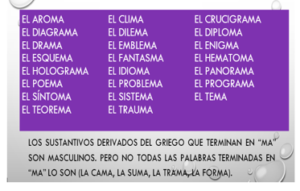
Then we have some professions, like “policía, guía, astronauta” ending always with “a”, either for men or women. This also affects all the words ending with -ista (dentista, economista, futbolista, tenista, etc.). Simply change the article to indicate that the person is either a man or a woman: la dentista se llama María, el dentista se llama José.
And finally, we have a group of words which are strictly feminine and end with -a, but we use the masculine article in front to avoid saying “aa”, which sounds uncomfortable for Spanish ears. So, instead of “la agua”, we say “el agua”. There are more words like this, and they are included on the video. This affects words carrying the accent on the first “a”, and also words which start with “ha”, because the “h” is totally mute. So we have: el agua, el aula, el arma, el hacha, etc. We also say “el azúcar”, although the accent is not on the “a”.
In another blog, we will discuss all the rules to know if words are feminine or masculine. Here is the video:
www.youtube.com/watch?v=LGok6_tvl1o&t=19s
